Reading a Casino Proposal Summary in One Sitting
Reading a casino proposal summary helps you separate what a Đồng Nai document says from what it leaves open, and identify the next record to request.
What can you responsibly say after reading a casino proposal summary in Đồng Nai? You can report the claims the document makes, identify who issued it, and mark the questions it leaves unanswered without treating a regional description as a project record.
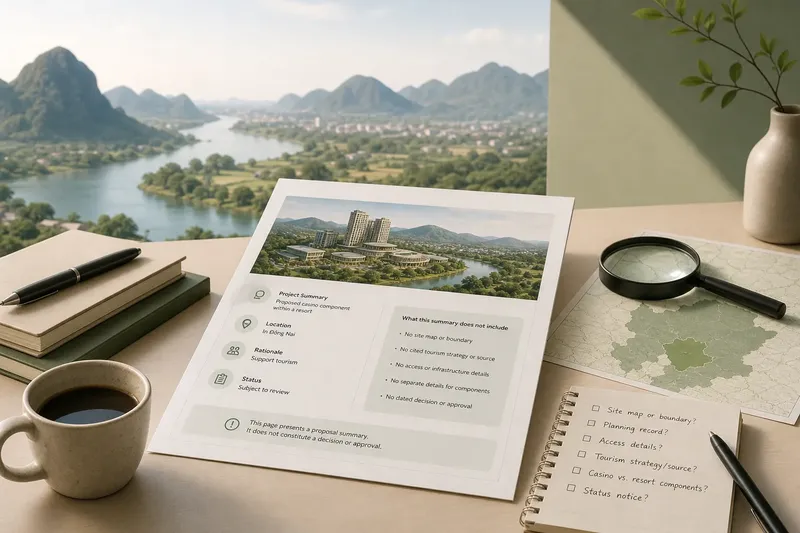
Say you receive an invented, hypothetical one-page summary that describes a casino component within a resort in Đồng Nai. It names the province, calls tourism a reason for the proposal, and mentions review, but includes no site map or decision notice. The useful account is not a verdict on the proposal; it is a precise description of what this page does and does not establish.
Start with the document
Record the title, issuing organization, date, and document type before paraphrasing its claims. A developer’s concept note, a public announcement, meeting minutes, and a formal decision are not interchangeable records, even when they describe the same project.
Keep the source beside each claim. If a developer’s note says that a resort would support tourism, attribute that rationale to the note. If it names a regional plan, identify the plan and the relationship the note claims; do not make the plan appear to endorse a casino unless its text says so.
Map the location claim
Location wording has levels of precision. “In Đồng Nai” identifies a regional setting; a district or landmark narrows the reference; a site plan or boundary description can identify a particular location. None should be silently substituted for another.
Check whether the document includes a map, boundary description, road reference, or named settlement, and note who supplied that detail. If the page gives only the province, write “in Đồng Nai” and leave exact location and proximity unresolved. A familiar place name is not a substitute for a mapped site.
Separate claim from context
A tourism narrative may describe destinations, visitor routes, or local development goals. It explains how the proposal is being framed, but does not by itself establish the project’s scope, approval status, or likely effects.
For the invented summary, imagine it says the resort would “support tourism” but names no strategy, route, or supporting document. A careful note would say that the summary presents tourism as a rationale and provides no cited regional source for that claim. The wording preserves the distinction between the proposal’s public explanation and the records behind it.
Match gaps to records
Use each missing detail to identify the next record or question. The following checks make the resulting account more useful without asking one document to answer a different kind of question.
- Site: Check whether the page includes a map or boundary. If it does, describe only the location shown; if it does not, ask for a site plan and leave proximity unresolved.
- Land use: Check whether a planning record is named. If it is, consult that record for its stated scope; if it is not, ask which planning document applies and do not infer compatibility.
- Access: Check whether roads or other access arrangements are described. If they are, report them as plans stated in the document; if they are not, request an access record rather than assuming existing routes serve the proposal.
- Tourism basis: Check whether the summary identifies a strategy or other source. If it does, compare the wording with that source; if it does not, attribute the rationale to the summary and ask what supports it.
- Project components: Check whether the casino and resort are described separately. If they are, keep each claim attached to its component; if they are not, avoid assigning resort details to the casino component.
- Status: Check whether the page names an issuing body and a dated decision. If it does, describe the decision in the record’s terms; if it does not, call the project a proposal and seek a separate status notice.
Questions about summaries?
Does a province name identify the site?
No. It establishes only the regional reference stated in the document. A site plan or more precise location description is needed to discuss boundaries or proximity.
Can a tourism plan confirm a proposal?
A regional plan can supply context, but it does not by itself establish that a separate casino proposal has been approved. Check its scope and consult a record that specifically addresses the proposal’s status.
What does “subject to review” establish?
The phrase says that review is mentioned, but does not identify the responsible body or show whether a review has begun. Look for a dated notice or another record that names the process.
How should an uncertain location be described?
Use the level of detail the source provides, such as “in Đồng Nai,” and state that the summary does not identify a precise site. That is more informative than adding an unsupported landmark.
Write with clear limits
For the invented summary, a bounded account could read: “The page describes a proposed casino component within a resort in Đồng Nai, presents tourism as a rationale, and mentions review. It supplies no mapped site, cited regional tourism source, or dated decision.” Each statement is tied to the page or to a plainly stated omission.
When reading a casino proposal summary, keep its geographic wording, tourism rationale, and status language attached to the documents that support them. That gives readers a useful account of what the page says—and a clear reason to ask for the next record.